
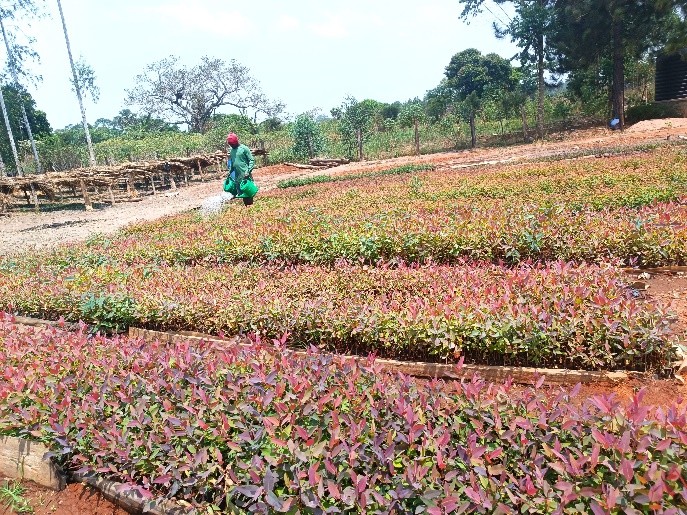
Community Road Empowerment (CORE Uganda) has completed a major environmental restoration initiative in Nakasongola District, aimed at addressing deforestation and land degradation in Uganda’s Cattle Corridor. The project focused on strengthening local tree nurseries and supporting farmers to establish practical, income-generating woodlots.
Implemented between July 2024 and May 2025 in Kakooge and Nakitoma sub-counties, the project responded to a growing demand for quality tree seedlings while tackling the environmental pressures caused by charcoal production, fuelwood harvesting, and declining forest cover.
At the heart of the initiative was the revitalisation of two commercial tree nurseries. Through targeted infrastructure upgrades, improved irrigation systems, and hands-on technical training, the nurseries significantly increased both the quantity and quality of seedlings produced. By the end of the project period, Biyinzika Nursery had produced over 18,000 seedlings, with strong survival rates, while IFOP Nursery more than doubled its production capacity, reaching over 40,000 seedlings.
Beyond production, the project placed strong emphasis on commercial viability. Thousands of seedlings were sold directly to private woodlot growers, timber out-growers, and charcoal producers, demonstrating that environmentally responsible practices can also be economically sustainable. Both nurseries adopted improved propagation methods, including mycorrhizal inoculation, which reduced seedling mortality and improved establishment success in the field.
On the farmer side, CORE supported 22 farmers to move away from scattered tree planting and instead establish compact, manageable woodlots. This shift reflected farmer preferences and practical realities on the ground. As a result, approximately 44 hectares of land were rehabilitated using fast-growing, charcoal-oriented species that align with local livelihoods while reducing pressure on natural forests.
The project also prioritised targeted seedling distribution. Farmers with demonstrated capacity, including members of the Amagezi Bwebugaga group, received large volumes of seedlings covering a diverse mix of 13 tree species. This approach balanced immediate fuelwood and charcoal needs with longer-term timber value and limited nutritional benefits through selected fruit trees.
To strengthen long-term environmental stewardship, the project extended beyond farmers to engage schools and youth. Tree planting activities held during the International Day of Forests brought students into the conservation effort, reinforcing awareness and responsibility among the next generation.
By combining technical training, business-oriented nursery strengthening, and farmer-led implementation, the initiative has laid a foundation for sustainable forest restoration in Nakasongola. The project demonstrates that locally driven solutions, when supported with the right skills and systems, can deliver measurable environmental and livelihood outcomes.
CORE continues to build on this model as part of its broader commitment to community-led development that is practical, scalable, and rooted in local realities.